90-minute intensive · METODOCC
Trauma and the how of emotional reconnection
Based on the experience of Eliezer Cohen (NATAL) with survivors of October 7: recognize what changed, stop merely enduring, reconnect your circles and take one step accompanied.

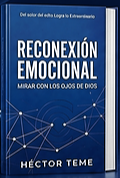 Companion bookReconexión Emocional · Seeing with God's eyesHéctor Teme. Each stage connects with a chapter of the book and a week of the 15-week training.Community in conversation
Step 1 of 6 · 0/6 completed
Your 90 minutes
Start here · 5 min
Opening video
Eliezer Cohen (NATAL) speaks in Spanish, with Spanish subtitles. The 90-minute clock covers the six stages: start it when you press play.
Step 1 · 10 min
Name what happened, without trivializing it
Open a safe space to look at the impact of what you lived through, without forcing the story or labeling it.
Emotional Reconnection · week 1
In the book Reconexión Emocional (Emotional Reconnection), Héctor Teme first invites you to see again: to recognize, with God's eyes, what has shut down in you. This stage is week 1 of the training: naming without judging yourself.
Eliezer Cohen, helpline manager at NATAL (Israel Trauma and Resiliency Center), has accompanied survivors, families and communities for years. After October 7, 2023, his team went from about two hundred weekly calls to thousands.
Cohen warns against two mistakes. One is trivializing the word “trauma,” like a teenager saying a teacher's clothes “traumatized” her. The other is turning every intense experience into a disorder: a rescuer can live the strongest moment of his life without developing post-traumatic stress.
This intensive is not therapy or diagnosis. It is coaching: we work on the how of your reconnection, your daily life and your relationships. You do not need to share the details of what hurt you. It is enough to recognize what changed in you.
What happened to you deserves to be named, not exaggerated or hidden.
Step 2 · 15 min
See the layers: what was lost at once
Recognize that a crisis can interrupt several parts of life at the same time.
Emotional Reconnection · weeks 2 and 3
The layers lost at once are the cycle of withdrawal the book describes: you stop doing, you isolate and life shrinks. Weeks 2 and 3 help you break that cycle by choosing a source of life that is meaningful to you.
Cohen describes layered crises: someone survives, loses a relative, finds their home damaged and discovers their community has scattered too. The supports that would normally help are hit at the same time.
Evacuated families were protected, yet they had lost work, school, neighbors and their place in the community. Life went on, but many reference points had disappeared. Trust can also break: when you expected protection and it did not come.
Sometimes the threat does not clearly end. So recovery does not always wait for everything to pass: Cohen saw people recover relationships and activities in the middle of the emergency.
Don't wait for everything to end before you start recovering something.
Step 3 · 15 min
Resilience is not just enduring
Move from the command to “be strong” to recognizing your resources and your need for support.
2 Corinthians 12:9 (NLT)
Emotional Reconnection · weeks 5 and 9
The book shows it is not about enduring but about anticipating grace before acting and retraining the negative lens pain leaves behind. Work on this in weeks 5 and 9.
«Each time he said, “My grace is all you need. My power works best in weakness.” So now I am glad to boast about my weaknesses, so that the power of Christ can work through me.»
Cohen is uncomfortable when “resilience” becomes an order to endure: that demand can hide the need for help. Suffering and the ability to cope can live in the same person.
He distinguishes personal resilience (living with grief and uncertainty, recognizing your abilities, finding ways to respond) from social resilience (belonging, mutual help, trust that together we can act).
NATAL's national survey (September 2026, 1,101 adults) showed a paradox. Over three years community resilience rose 18% while personal resilience fell 32%. Nearly one in four people remained at clinical risk of post-traumatic stress, and distress did not ease from one year to the next. Without support, prolonged pain settles in.
The group moving forward does not tell how you are. That is why you need to ask yourself, honestly, how you are.
From a faith perspective, lingering pain is not a lack of faith. God's power is made perfect in weakness, not in the appearance of strength.
Being strong also means allowing yourself to be accompanied.
Step 4 · 15 min
Reconnect your circles of life
Look at your recovery in four areas: you, your family, your community and your sources of help.
Romans 12:15 · Ecclesiastes 4:9–10 (NLT)
Emotional Reconnection · week 13
The safe person and the request for help are the gratitude, generosity and social connection of week 13 in the book. From NATAL's experience, it helps to bring this reconnection with others into the very first weeks.
«Be happy with those who are happy, and weep with those who weep.»
«Two people are better off than one, for they can help each other succeed. If one person falls, the other can reach out and help. But someone who falls alone is in real trouble.»
NATAL's ecological model considers four interacting areas: individual, family, community and society. Helping one person loses strength if their family is overloaded or their community scattered.
What sustained many were everyday bonds: nearby extended family, neighbors, school parents, a WhatsApp group, coworkers, a faith community with shared meaning, routines and quick practical help. According to the survey, belonging protected 75%, and close circles were the main source of daily relief (40%), ahead of formal therapy (15.4%), which is still needed when called for. Isolation weighs heavily: almost half of those with thoughts of taking their own life lacked belonging. When personal reserves run empty, the circle works as an external generator.
NATAL works in a cycle: routine, emergency, recovery and growth. Bonds are built in routine so they are available in the emergency. Transitions matter too. Returning to routine can be harder than the emergency: someone coming back may stay on alert, talk less or react as if the danger continued. That return needs accompaniment.
Romans invites us to weep with those who weep. The Christian community has a concrete task: listen, ask what company is welcome and, if the person wishes, pray with them.
Reconnection begins with one safe person and one possible step.
Step 5 · 25 min
Go deeper with CoachGPT
Bring your reflection to a METODOCC conversation: rehearse your request for help and design one possible step for the next seven days.
Emotional Reconnection · week 4
Your CoachGPT conversation applies week 4 of the book, Taking steps toward life: one small step matched to your energy, with day, time and support.
The conversation starts from what you wrote. CoachGPT will not ask you to retell what hurt you: it will work with you on the how of your reconnection, from your vision and purpose, with a step matched to your available energy. If intense or persistent suffering affects your daily life, it will encourage you to also seek a mental health professional.
You don't have to recover everything today; just take the next step accompanied.
When you begin, your written reflections will be shared with CoachGPT and saved in this conversation.
Sign in to talk with CoachGPT right here. Your answers and the clock stay saved.
Sign inStep 6 · 10 min
Declare your step and your support network
Leave with a free, concrete and reviewable commitment, and with your network identified.
Psalm 34:18 (NLT)
Emotional Reconnection · weeks 14 and 15
Your commitment and your plan to come back are weeks 14 and 15 of the book: a personal plan of positive emotion and relapse prevention so you know how to return when you shut down.
«The LORD is close to the brokenhearted; he rescues those whose spirits are crushed.»
Cohen closes with a principle: those who call must find company, and those who help also need to feel accompanied. If you accompany others, seek supervision and spaces to share what affects you.
Choose an action matched to your energy, with day, time and support. For example: “On Saturday I'll walk fifteen minutes with my sister. If I get tired, we'll sit and talk.” And define your plan to come back: if I isolate again, who will I tell?
The Lord is close to the brokenhearted.
Your written reflections remain on this device unless you share them with CoachGPT.
Optional prayer: Lord, you are close to the brokenhearted. Heal what hurts in me, give me safe people to walk with and the courage to take the next step. Amen.
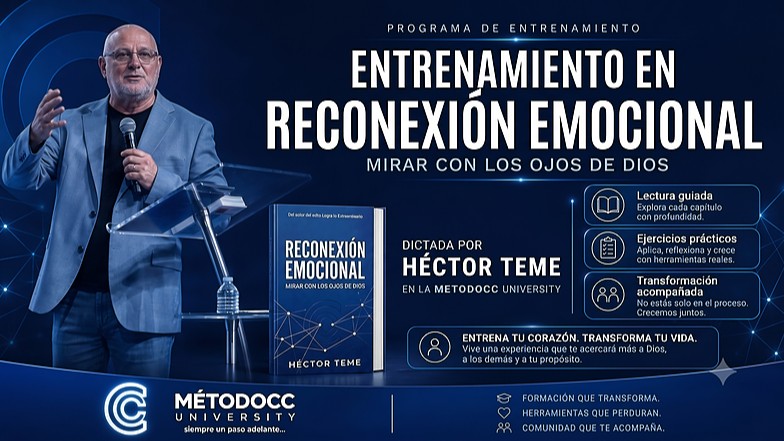
Keep reconnecting: 15 weeks with the book
This intensive opens the way. The book Reconexión Emocional and its training take you from shutting down to vitality, one week at a time, with CoachGPT by your side.
Community in conversation
What did this intensive awaken in you? What are you putting into practice, and what is changing?
Loading…