90-minute intensive · METODOCC
Marriage in the times of Jesus
Learn from the Eastern customs of the Bible about marriage to build a happy marriage: a 25-minute video and 65 minutes of stages with coaching.
 Community in conversation
Step 1 of 6 · 0/6 completed
Your 90 minutes
Start here · 25 min
Opening video
Start the clock when you press play. After the video, continue with the six stages.
Step 1 · 5 min
Pause: see your marriage with new eyes
Make room to look at your marriage through the Eastern customs that illuminate the Bible, without blame or comparison.
Americans and Europeans are very surprised to learn that in many parts of the East marriages are still arranged by the parents, just as they have been for centuries. Yet, despite the apparent lack of freedom of choice involved in the system, there is a remarkable absence of divorce, and the children born of these unions do not become juvenile delinquents.
Let us examine some of these customs as the Holy Spirit reveals them, because the Bible is full of parables and figures of speech on the subject: choosing the bride, the veil, the ten pieces of silver, the torches of the ten virgins, the wedding garment, the vows and the salt, the wedding at Cana, the year-long honeymoon and the promise to prepare a place.
A happy marriage begins by seeing it the way God designed it.
Step 2 · 10 min
Choosing and being chosen: humility and a face without wrinkles
Recognize the qualities that strengthen the covenant: humility, calm and trust in God.
First, there is the matter of choosing the bride. Careful parents spend a great deal of time on this. They reject a young woman like the one described in Isaiah 3:16. Walking 'with outstretched neck' is a sign of pride and arrogance that parents watch for.
You should remember that Paul instructed the women of the first-century church to dress with decency (1 Timothy 2:9). I do not like the words 'with shamefacedness and sobriety' the translator used in this verse. A better word would be 'humility'; that is the quality parents look for in a future bride for their son.
When the text speaks of 'tinkling with their feet', it refers to the many jewels Eastern women wear around their ankles. Modest young women always walk carefully so these jewels do not ring loudly; arrogant ones make them ring as they walk so they can be heard.
Another thing they consider is whether the future bride has a furrowed brow. Eastern women of any age are to take pride in their calm and composure, their self-control, because a worried look on the face shows a lack of trust in God. This helps us better understand Paul's words about a glorious church 'without spot or wrinkle' (Ephesians 5:27). In other words, your faith should be so great that you carry no wrinkles of anxiety or distrust of God on your face. Job tells his 'miserable comforters' that they have filled him with wrinkles (Job 16:8).
If the parents examining the bride notice signs of worry on the young woman's face, they think to themselves: 'Look how worried she seems; if he marries her, she will worry our son to death!' And that candidate is then turned down.
Scripture · New Living Translation
Isaiah 3:16 (NLT)
The Lord says, “Beautiful Zion is haughty: craning her elegant neck, flirting with her eyes, walking with dainty steps, tinkling her ankle bracelets.
1 Timothy 2:9 (NLT)
And I want women to be modest in their appearance. They should wear decent and appropriate clothing and not draw attention to themselves by the way they fix their hair or by wearing gold or pearls or expensive clothes.
Ephesians 5:27 (NLT)
He did this to present her to himself as a glorious church without a spot or wrinkle or any other blemish. Instead, she will be holy and without fault.
Job 16:8 (NLT)
As if to prove I have sinned, you’ve reduced me to skin and bones. My gaunt flesh testifies against me.
The peace on your face is also a gift to your marriage.
Step 3 · 10 min
The veil and the ten pieces of silver
Discover which symbols and gestures sustain love, and what to do when something valuable feels lost.
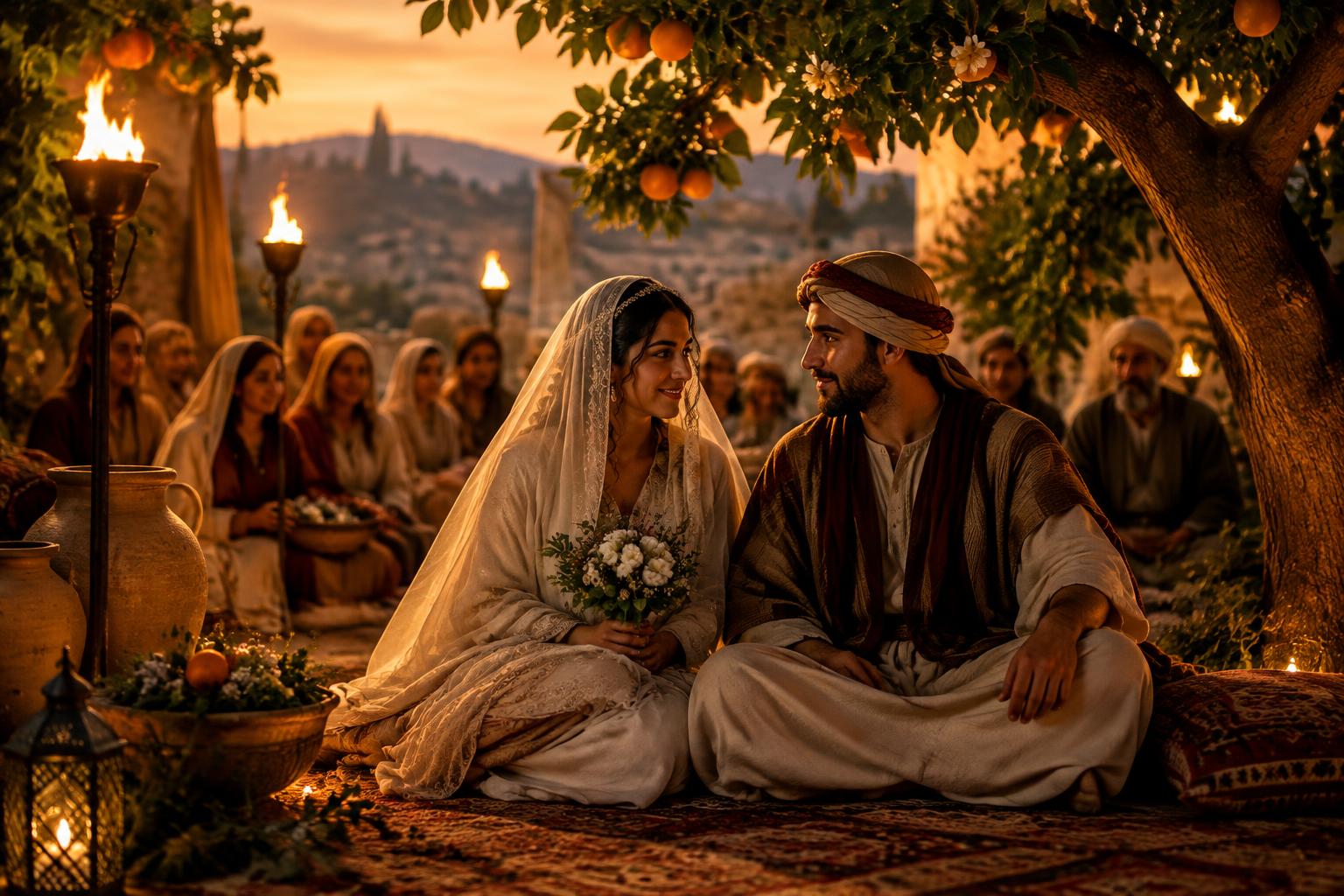
When the bride has finally been chosen, the two families are ready to prepare the wedding ceremony. It is a very solemn occasion. The families share a meal and then go out together into the garden. In many parts of Persia, Arabia, Syria and India gardens have plants considered sacred, and one of them is the Kitchilika tree (Kit-chi-li-ka), an exotic, fragrant kind of orange tree whose fruit is about the size of a grape. It is a beautiful tree, and its sweet scent can be noticed from a distance when its fruit is ripe.
A carpet is spread, and the young woman's mother brings her out of the house to sit facing the groom. She keeps her veil over her face, of course, since it is considered improper for the groom to see the bride's face before the ceremony is concluded. Eastern people who keep this custom believe the veil is a sign of the protection God gives her. Not even a thief dares attack a veiled woman, convinced that if he does he is attacking God himself. Remember when Rebekah looked up, saw Isaac and covered herself with her veil (Genesis 24:64-65).
The young couple now sit on the carpet looking at each other. The bride cups her hands and holds them out to the young man, and he drops the ten pieces of silver into them. These coins had been set aside and kept in the groom's family home for this purpose and occasion. One side bears the groom's family coat of arms; the other, the year they were minted. These young Eastern women were taught: 'The one who places the ten pieces of silver in your hands is the one who will love you.' They believe God's love floods the young woman's heart the moment the coins are placed in her hands. This moment, then, is the beginning of love, under the sacred Kitchilika tree.
Now read Song of Songs 8:5 with me. Unfortunately, the translators never saw or heard of a sacred tree called Kitchilika, so they did their best and substituted the word 'apple tree'. Apple trees appeared botanically much later and have existed for only a few hundred years.
By receiving the ten pieces of silver, the bride is considered purchased, in the same sense that Christ died for us on the tree and bought us as the bride is bought. 'For you were bought at a price' (1 Corinthians 6:20). Christ paid the price for us.
The bride also receives other jewels at the ceremony, but none will carry the meaning the ten pieces of silver have for her. Although, melted down and sold as metal, each might be worth no more than a quarter, they hold a tremendous and very important symbolism for her. She wears them fastened in her hair with small hooks during the ceremony and must keep them with her all her life.
You will remember the parable Jesus told about the woman who lost one of her ten pieces of silver (Luke 15:8). It is striking how badly the Western world has misunderstood this parable, not appreciating the importance of this Eastern belief! Some students have said the woman was poor and needed the money, and that is why she swept her house and, finding the coin, called her neighbors to rejoice with her.
In the Eastern way of thinking, if a woman loses one of her ten pieces of silver, God withdraws his favor from the family home, and the blessings it had are lost. If she cannot find the coin, she will be thrown into the street as an outcast; they will leave her to die! No wonder the poor woman sweeps the house desperately until she finds it, and calls her neighbors to rejoice with her when she does, because it means she has escaped rejection. And Jesus said that this joy is like the joy in heaven when a sinner repents.
Scripture · New Living Translation
Genesis 24:64-65 (NLT)
When Rebekah looked up and saw Isaac, she quickly dismounted from her camel. “Who is that man walking through the fields to meet us?” she asked the servant. And he replied, “It is my master.” So Rebekah covered her face with her veil.
Song of Songs 8:5 (NLT)
Who is this sweeping in from the desert, leaning on her lover? I aroused you under the apple tree, where your mother gave you birth, where in great pain she delivered you.
1 Corinthians 6:20 (NLT)
for God bought you with a high price. So you must honor God with your body.
Luke 15:8-10 (NLT)
“Or suppose a woman has ten silver coins and loses one. Won’t she light a lamp and sweep the entire house and search carefully until she finds it? And when she finds it, she will call in her friends and neighbors and say, ‘Rejoice with me because I have found my lost coin.’ In the same way, there is joy in the presence of God’s angels when even one sinner repents.”
What is valuable in your marriage is not stored away: it is cared for and sought.
Step 4 · 15 min
Ten days of wedding, vows, salt and a year together
Renew commitment and priority: what you promised, how you care and how much time you give your marriage.
The wedding ceremony lasts ten days. Because it is considered a sacrament, the whole neighborhood takes part. Any program, any time of prayer and fasting under way, must be set aside for those ten days, since they are convinced God's presence is in the wedding ceremony. ('Fasting' can mean going without food; it can also mean doing God's will.) If a man has a dispute with another at that time, he must first go and ask forgiveness, so he can stand before the Lord with an uncovered face. This is the situation described in Matthew 9:15: the verse refers to the custom of suspending prayer and fasting while the ceremony lasts; when it ends, they may resume the prayers and fasts they were keeping.
Matthew chapter twenty-five describes another interesting Eastern custom: the parable of the ten virgins. In many parts of the East today, the custom of ten virgins (bridesmaids) going out to meet the groom is still practiced. Many cities are surrounded by walls, and at the city gate there is an entrance for travelers, with a place set apart where the virgins wait to meet the bridegroom. The torches they carry (not lamps!) are very special, made many years before for the occasion and carefully handed down from generation to generation.
Tradition says the groom arrives around midnight, and that is exactly what Scripture records. One of the groom's companions goes ahead to announce his coming by blowing a horn at the city gates. The foolish virgins wake up and realize they have no oil in their torches, and they have to invent an excuse: 'Our torches are going out', even though a few verses earlier it says they took no oil at all! I grew up in a culture that still practices this tradition, and I have never heard of a young woman forgetting to take oil for her torch. Yet Jesus tells the story this way to illustrate that the oil represents the Spirit and the light we have within when we accept Christ as personal Savior; we must have that Spirit if we hope to be admitted at the Master's door with the rest of the wedding guests.
Besides the torches there are also special wedding garments provided for the guests, decorated with ribbons and ornaments that show the house and lineage they belong to (Matthew 22:11-13). At the wedding of a king's son (Matthew 22:2), the marriage takes place not in the bride's house but in the palace, and each guest receives a special garment bearing the royal seal, sent to his home a day or two before. Showing up without it would be a serious, unforgivable breach of etiquette! On arrival, the guest first passes through an entry room where a servant of the lowest rank receives his sandals to wash his feet (Psalm 108:9); then another servant sprinkles him with rose water. Neither has authority to confront him. Only when the host greets him with a 'holy kiss' is the guest without a garment discovered.
The guest remained silent, and rightly so: he had been given the opportunity to come properly dressed, but he deliberately refused to wear the royal garment. He was no stranger; he knew the custom perfectly. In the same way, God has already sent us his Garment of Righteousness in his Son. If our heart puts on this garment, we wear the clothing of salvation. We must clothe ourselves with Christ to appear without spot or wrinkle before God.
Each of the ten virgins has a day on which she performs a special role. The bride and groom sit together for half an hour on a decorated seat to hear the priest's instructions, which they have heard before but are reminded of on this sacred, solemn occasion. On the tenth day the vows are repeated. The groom promises to love and care for his wife all his life; the bride promises to accept her husband in her life in the place of God, to obey and serve him as she would the Lord himself. Paul refers to this custom in 1 Corinthians 7:34.
Then salt is brought, and each takes a piece and places it on the tongue, saying: 'In the name of the salt I agree to do all I have promised, so help me God!' There are no wedding rings as in the West; instead a silver cord is placed around the young woman's neck. Now the groom may lift the veil and see his bride's face for the first time. He carefully lifts the veil —with fear and trembling, I suppose— and lays it on his shoulder. This symbolizes that the protection God gives the woman now rests on his shoulders. This is the meaning of Isaiah 9:6: 'The government will rest on his shoulders.' Christ bought us at a price and has taken our responsibility upon himself. Then the couple go to the feast, set under a special covering on the roof that signifies God's protection extending from above.
It was at a wedding celebration in Cana of Galilee that Jesus performed his first miracle, turning water into wine (John 2:1-10). The older rendering 'Woman, what have I to do with thee?' should read: 'Dearest mother, what can we do yet? My turn has not yet come.' It refers to the sacred custom of providing the wine by order of age: the eldest first and the youngest last. Jesus, at 30, did not yet have his turn. In Eastern places where marriage is a sacrament, fermented wine is not used; that 'wine' was grape juice. John includes this account to give further proof that Jesus was the Son of God.
After the feast the couple begin their honeymoon. They do not live together right away: they wait for a date set by the priest. This explains Matthew 1:18 and 1:20: Joseph and Mary were already married but had not yet come together. The honeymoon lasted a year: one month with the bride's parents and the next with the groom's. They always ate together. If a man is invited to dinner within a year of his wedding, he answers: 'I just got married, so I cannot accept' (Luke 14:20). It is no weak excuse: eating away from home, apart from his wife, is unthinkable.
At the end of the twelve months, family, friends and bridesmaids gather again, and the husband makes a solemn declaration to his wife: they are the words Jesus spoke to his disciples at the Last Supper (John 14:1-4). He must go and prepare a place, their private nest, and in due time he will return for her. The bride listens and answers: 'Whatever you say, I will do.'
It surprises me that many Christians today cannot believe the promise Christ made us, and are not as calm and joyful as the Eastern bride is about her husband. I believe it is because we do not know Christ the way the bride knows her husband. They had spent a whole year together. If those of us who confess Christ spent a whole year growing in the things and thoughts of the Spirit, never eating a meal without praying first and always thinking about how to please the Lord, we could fully believe his promises and answer him: 'Whatever You say, I will do.'
Scripture · New Living Translation
Matthew 9:15 (NLT)
Jesus replied, “Do wedding guests mourn while celebrating with the groom? Of course not. But someday the groom will be taken away from them, and then they will fast.
Matthew 25:1-13 (NLT)
“Then the Kingdom of Heaven will be like ten bridesmaids who took their lamps and went to meet the bridegroom. Five of them were foolish, and five were wise. The five who were foolish didn’t take enough olive oil for their lamps, but the other five were wise enough to take along extra oil. When the bridegroom was delayed, they all became drowsy and fell asleep. “At midnight they were roused by the shout, ‘Look, the bridegroom is coming! Come out and meet him!’ “All the bridesmaids got up and prepared their lamps. Then the five foolish ones asked the others, ‘Please give us some of your oil because our lamps are going out.’ “But the others replied, ‘We don’t have enough for all of us. Go to a shop and buy some for yourselves.’ “But while they were gone to buy oil, the bridegroom came. Then those who were ready went in with him to the marriage feast, and the door was locked. Later, when the other five bridesmaids returned, they stood outside, calling, ‘Lord! Lord! Open the door for us!’ “But he called back, ‘Believe me, I don’t know you!’ “So you, too, must keep watch! For you do not know the day or hour of my return.
Matthew 22:2 (NLT)
“The Kingdom of Heaven can be illustrated by the story of a king who prepared a great wedding feast for his son.
Matthew 22:11-13 (NLT)
“But when the king came in to meet the guests, he noticed a man who wasn’t wearing the proper clothes for a wedding. ‘Friend,’ he asked, ‘how is it that you are here without wedding clothes?’ But the man had no reply. Then the king said to his aides, ‘Bind his hands and feet and throw him into the outer darkness, where there will be weeping and gnashing of teeth.’
Psalm 108:9 (NLT)
But Moab, my washbasin, will become my servant, and I will wipe my feet on Edom and shout in triumph over Philistia.”
1 Corinthians 7:34 (NLT)
His interests are divided. In the same way, a woman who is no longer married or has never been married can be devoted to the Lord and holy in body and in spirit. But a married woman has to think about her earthly responsibilities and how to please her husband.
Isaiah 9:6 (NLT)
For a child is born to us, a son is given to us. The government will rest on his shoulders. And he will be called: Wonderful Counselor, Mighty God, Everlasting Father, Prince of Peace.
John 2:1-10 (NLT)
The next day there was a wedding celebration in the village of Cana in Galilee. Jesus’ mother was there, and Jesus and his disciples were also invited to the celebration. The wine supply ran out during the festivities, so Jesus’ mother told him, “They have no more wine.” “Dear woman, that’s not our problem,” Jesus replied. “My time has not yet come.” But his mother told the servants, “Do whatever he tells you.” Standing nearby were six stone water jars, used for Jewish ceremonial washing. Each could hold twenty to thirty gallons. Jesus told the servants, “Fill the jars with water.” When the jars had been filled, he said, “Now dip some out, and take it to the master of ceremonies.” So the servants followed his instructions. When the master of ceremonies tasted the water that was now wine, not knowing where it had come from (though, of course, the servants knew), he called the bridegroom over. “A host always serves the best wine first,” he said. “Then, when everyone has had a lot to drink, he brings out the less expensive wine. But you have kept the best until now!”
Matthew 1:18 (NLT)
This is how Jesus the Messiah was born. His mother, Mary, was engaged to be married to Joseph. But before the marriage took place, while she was still a virgin, she became pregnant through the power of the Holy Spirit.
Matthew 1:20 (NLT)
As he considered this, an angel of the Lord appeared to him in a dream. “Joseph, son of David,” the angel said, “do not be afraid to take Mary as your wife. For the child within her was conceived by the Holy Spirit.
Luke 14:20 (NLT)
Another said, ‘I just got married, so I can’t come.’
John 14:1-4 (NLT)
“Don’t let your hearts be troubled. Trust in God, and trust also in me. There is more than enough room in my Father’s home. If this were not so, would I have told you that I am going to prepare a place for you? When everything is ready, I will come and get you, so that you will always be with me where I am. And you know the way to where I am going.”
Love promised with salt is sustained by presence every day.
Step 5 · 20 min
Coaching with CoachGPT for your marriage
Bring your reflections into a METODOCC conversation: see what you could not see, open a new possibility and choose an action that depends on you.
The conversation starts from what you wrote. Bring the piece of silver you want to recover, the promise you want to renew and the time you want to give. CoachGPT will accompany you from your vision of a happy marriage, without advising or doing couples therapy. If there is violence, abuse or risk, seek professional help and a safe place first.
Something extraordinary in your marriage can begin with one conversation.
When you begin, your written reflections will be shared with CoachGPT and saved in this conversation.
Sign in to talk with CoachGPT right here. Your answers and the clock stay saved.
Sign inStep 6 · 5 min
Declare: 'Whatever you say, I will do'
Leave with a free, concrete and reviewable commitment, and a renewed response to God.
The Eastern bride answers her husband's promise with trust. We answer Christ, who went to prepare a place and will return: 'Whatever you say, I will do.' From that response, choose one step for your marriage that depends on you, without demanding that your spouse feel or act a certain way.
A happy marriage is built with small promises kept every day.
Your written reflections remain on this device unless you share them with CoachGPT.
Optional prayer: Lord, thank you for my marriage. Help me care for what is valuable, keep my promises and love as you love us. Whatever you say, I will do. Amen.
Community in conversation
What did this intensive awaken in you? What are you putting into practice, and what is changing?
Loading…
More materials by Héctor Teme and METODOCC
PRECIO-DESPRECIO-APRECIO
When a couple enters 'price mode', everything is charged. How to build lasting value in your marriage.
Reconexión Emocional
Fifteen Christian coaching sessions to overcome inner shutdown and reconnect with your emotions.
Mirando desde el Otro Lado
Seeing more means understanding more, shifting paradigms, managing emotions and working on blind spots.
Mujeres Poderosas
Powerfully biblical as mother, wife and entrepreneur: activation, formation and strategic clarity.
Sesiones de Coaching Personales
One-to-one coaching with the METODOCC team. Book a free exploratory session.